Flutter vs Native Android Development: Which Should You Choose?
A practical guide to choosing between Flutter and native Android or iOS: how each works, where each wins, what they cost and what to ask a vendor.
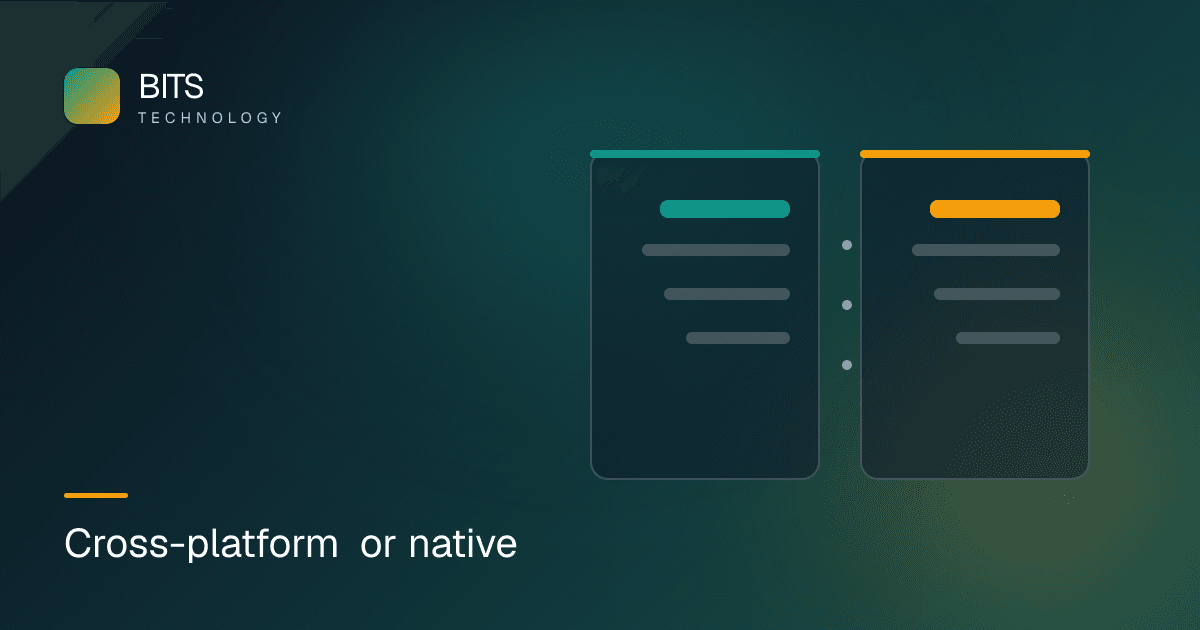
“Should we use Flutter or build natively?” is usually asked too early. The framework is a consequence of other decisions: how many platforms you support, what the app must touch on the device, which SDKs you cannot avoid, and who maintains it three years from now. Answer those and the framework mostly picks itself. What follows is how the two differ, where each wins, what each costs after launch, and what to ask a vendor.
The real question is one codebase or two
Flutter is not competing with Kotlin. It is competing with the decision to run two separate mobile products: two languages, two toolchains, two test suites, two release trains, and in practice two engineers who each know only their half.
The extra cost is not double the code — it is coordination. A bug gets fixed on Android and lingers on iOS; a screen is redesigned on one platform and quietly drifts on the other. Teams that keep two native apps genuinely in step do it deliberately, with a shared spec, a shared API contract and QA that tests both against the same criteria.
The corollary matters too. If you ship Android only and truly never add iOS, the strongest argument for Flutter evaporates and the choice is about tooling and team skills. If iOS is coming within a year or two, decide now: retrofitting cross-platform onto a finished native app is a rewrite, not a migration.
How each one actually works, and why it matters
Flutter draws its own interface
Flutter bundles a rendering engine inside your app and paints every pixel itself instead of wrapping the platform's UI controls. Dart compiles ahead of time to native machine code for release builds, so performance is not an interpreter question — it is a question of how much you make the app draw.
The upside: the interface is identical on both platforms, and heavily custom UI is cheaper because you are drawing it anyway, once. The cost: your app does not inherit new system behaviour automatically — when a platform changes how pickers, share sheets or text selection work, you get it when the framework's widgets catch up, not the day the OS ships. And anything the OS owns — push, permissions, biometrics, background execution, in-app purchases, deep links, hardware access — reaches Dart through a platform channel that is native code on each side. A Flutter project is never entirely free of Kotlin and Swift.
Native uses the platform's own toolkit
Kotlin with Jetpack Compose and Swift with SwiftUI or UIKit give you every API the moment it ships, first-party profiling with no framework in between, and accessibility, text input and system gestures straight from the OS rather than from a re-implementation. The price is that everything is built twice, including the parts that have nothing to do with the platform: data models, validation, API clients, formatting, offline caching, analytics events.
Criteria that settle most decisions
| If this is true for you | Lean | Why |
|---|---|---|
| iOS and Android at launch, one budget | Flutter | Feature parity is free instead of negotiated |
| The core feature is a device capability | Native | Camera pipelines, low-latency audio, BLE peripherals and sensors sit closest to the metal |
| Android only, permanently, with a Kotlin team | Native | Nothing to share, and you keep first-party tooling |
| Required SDKs ship as native libraries only | Native, or budget wrappers | Each wrapper is code you own and re-verify on every SDK update |
| Cold start and install size are the product edge | Native | A bundled engine sets a size and startup floor |
Weight these rather than scoring them. One hard requirement — an exclusive native SDK, an audio engine, a wearable at the centre of the product — outweighs five soft preferences.
Where Flutter is the right call
Most business apps are lists, forms, detail screens, maps, search and push notifications: catalogues, booking, delivery, loyalty, field-service and CRM companions, internal operations tools. Flutter handles that class comfortably, and the shared codebase compounds on every feature after the first.
It is also the pragmatic answer when the product is unproven — you want to learn whether people use it before perfecting it twice — and when the team is small: one CI pipeline, one crash-reporting integration, one place where a fix lands. Our EatWise case study has that shape: a cross-platform nutrition app built in Flutter with a Wear OS companion, because the product needed the same features on both platforms without two roadmaps. See mobile app development for how we structure that work.
Where native is the right call
Native earns its extra cost when the app's core value is a platform capability rather than a screen: per-frame camera processing, on-device machine learning that uses the platform accelerators, low-latency audio, real-time video, demanding 3D, unusual Bluetooth LE peripherals, NFC, Android Auto or CarPlay, and complex background execution. So does any product where system widgets, watch apps or OS extensions are first-class — those are written natively even inside a Flutter project. The other case is a vendor SDK that exists only as native libraries and changes often: every release then becomes a wrapper you must re-test on both sides.
The costs that only appear after launch
Some maintenance is unavoidable either way. Google Play requires apps to keep targeting a recent API level, so no mobile app is ever finished; each OS release adjusts permissions, background limits or notification behaviour; and iOS builds need a Mac for compilation and signing whichever framework you choose.
Flutter adds framework and plugin upgrades. A major version bump cascades through dependencies, and an abandoned plugin on a critical path is a real risk: count the plugins you will need before you start, check each one's maintenance activity, prefer official packages, and accept that you may have to fork one. Budget for an engineer who reads Kotlin and Swift — the hardest bugs live at the Dart-to-native boundary.
Native adds coordination, paid in small increments until a client asks why the iOS app is missing a filter the Android app has had for months.
What changes when your users are in Uzbekistan
Devices, networks and offline behaviour
Assume a wide device range rather than current flagships, and connectivity that drops. Measure cold start and install size on the cheapest phone you can find, and make that a release gate. For driver, delivery and field-sales apps, design offline-first: a local store, a queue of pending actions and explicit conflict rules. Both approaches support this — the difference is that you build the sync layer once in Flutter and twice natively.
Local integrations
Payment, banking, identity and e-signature providers in the region often distribute native Android and iOS SDKs rather than cross-platform packages. Before choosing, list every third-party SDK the app must use and check each for a maintained Flutter package. Where there is none, the work is a platform-channel wrapper per platform — a known, estimable cost, but only if you learn about it before the estimate. If the app also talks to accounting, warehouse or dispatch systems, the harder engineering is the system integration behind it.
Three languages, and staffing year four
Uzbek, Russian and English in one product changes layout work: Russian labels run longer than their English equivalents, so test every screen in the longest language, and check Latin and Cyrillic glyph coverage in the typeface you choose. Flutter renders text with its own engine, so the font you bundle is what users see; native inherits a system font that varies between manufacturer builds of Android. This is UI/UX design work, far cheaper before development than after. Staffing follows the same logic: two native codebases need a durable specialist on each side, while a Flutter product needs one team plus an engineer comfortable in native code. Ask a vendor how they would staff year four, not month one.
Questions to ask before you sign
- Which parts of this app cannot be written in Dart, and how will you write them?
- Of every third-party SDK we need, which have maintained cross-platform packages and which need a native wrapper?
- What happens if a plugin on the critical path is abandoned mid-project?
- Walk me through the release process: signing, CI, staged rollout, crash reporting, rollback.
- If we build Android only now and add iOS next year, what would actually be reused?
- Who owns the source code, and are the App Store and Google Play accounts in our name?
- What does maintenance cover for OS releases and target-API bumps, and who starts it?
- What is the minimum device you support, and can you demonstrate the app running on it?
Concrete answers to these tell you more about the outcome than any framework comparison.
Mistakes we see most often
- Choosing by developer preference and calling it architecture. Preference is a legitimate input — a team is faster in the stack it knows — but state it rather than disguising it as a technical requirement.
- Assuming Flutter means no native work. Push, permissions, payments and background tasks all touch platform code.
- Designing one platform and porting it. Back navigation, gestures and tab placement differ; a pixel-perfect port still feels wrong on the second platform.
- Treating the backend as an afterthought. Most reports of a slow app trace back to API latency and payload size, which is software engineering work, not framework work.
- Costing only the build. Two years of maintenance often exceeds the first release, and it is the part most proposals leave out.
Summary
For most business apps that need iOS and Android, Flutter is the correct default: it removes a whole class of coordination cost and lets a small team keep both platforms in step. Choose native when a device capability, an exclusive SDK, or a hard startup and size constraint is central to the product — or when you are genuinely single-platform and have the team for it.
Then stop optimising the framework and start on what decides whether the app succeeds: a clear core flow, a fast and reliable API, real-device testing and honest analytics. Describe what your app must do and contact us — we will tell you which way we would build it, and why.